
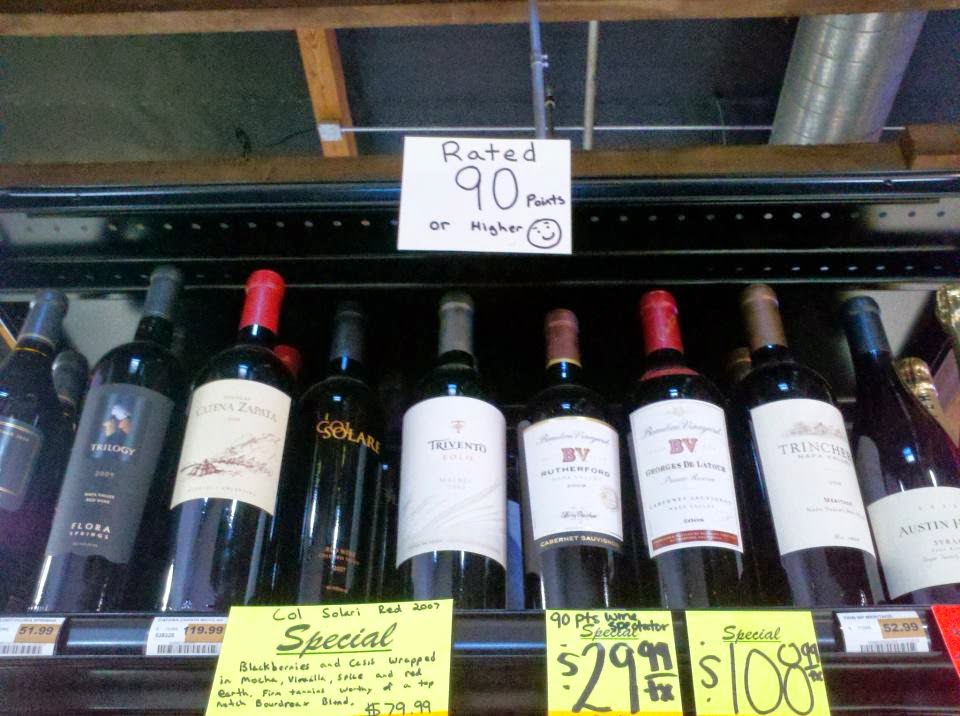
“The much respected American wine critic Robert Parker took his country by storm in the early 1980’s by introducing a universal scoring system for wines to accompany his admirable published tasting notes (originally in his monthly newsletter The Wine Advocate). The explanation of his system is lengthy, but the outcome is that most fair to good wines are awarded scores between about 70 and 100. No wine can score less than 50.
The simplicity of attaching scores to wines had instant appeal in America and the “100-point system” has been successfully adopted by the very influential Wine Spectator. Indeed it is hard to imagine the American wine trade ever abandoning a system of such seductive but unfortunately misleading simplicity.
Scoring is used by most professional wine judges as a working yardstick. In many countries a 20-point system is used, with (for example) 3 points being given for colour, 5 for aroma or bouquet, 9 for flavour and 3 for overall quality (there are many variations on this). In the press of professional judging, with a need to arrive at consensus rapidly, such systems are useful tools, although widely understood as having shortcomings. True consensus is arrived at not by numbers, but by words in subsequent discussion. Among non-professional wine-buyers numerical scoring of wine conveys a totally false impression. First, it asserts the existence of objective absolutes which can be measured. In the world of wine there are no such things. Second, it implies that the measure of one day will hold still true months or indeed several years later. No taster, however gifted, can guarantee a precise once-for-all measure of wine quality. (An aggravated weakness of the system is that it is used in judging wines in their earliest stages of development, long before they are even bottled At this stage large differences in market value are at stake). But perhaps the most serious indictment of publishing such scores is that it teaches the layman to believe that all wines are in competition with each other; that they are all trying to achieve a perfect 100 points.
There is no room in a pocket-book to develop the contrary thesis; there is just room to say that the most precious quality of wine is its variety; variety not only of colour, scent, flavour, strength and longevity, but of purpose, aspiration and philosophy. All wines are competing for your money, yes. But some hope to win it in joyful simplicity, others as complex works of art, others as sheer refreshment. There is no common factor, objective or subjective, that can justify numerical scores as a means of interpreting such a rich diversity.”
–Hugh Johnson in Hugh Johnson’s Pocket Encyclopedia of Wine; 1992 edition; Fireside, an imprint of Simon & Schuster. Last page, last four paragraphs. Bold emphasis added by me
 Stephen McConnell